How a hail damage roof claim works in Oklahoma
The whole process from the first inspection to the depreciation check, with the parts that changed since 2023 — percentage deductibles, ACV roof schedules, shorter notice periods — and the state law that says what a roofer can't do.
Oklahoma is one of the three or four worst states in the country for hail, and Tulsa County is one of the worst counties in Oklahoma: 391 spotter hail reports since 2004, May 21, 2024 tennis-ball hail in south Broken Arrow and Jenks, two-inch hail on May 19, 2025, 1¾-inch on May 8, 2026. Filing a roof claim here is routine. Filing one well — so it's approved, paid in full and doesn't leave you with a roof that's worse than the money — takes knowing how the process works and what's changed in the last three years.
Step 1: Get it inspected before you call the carrier
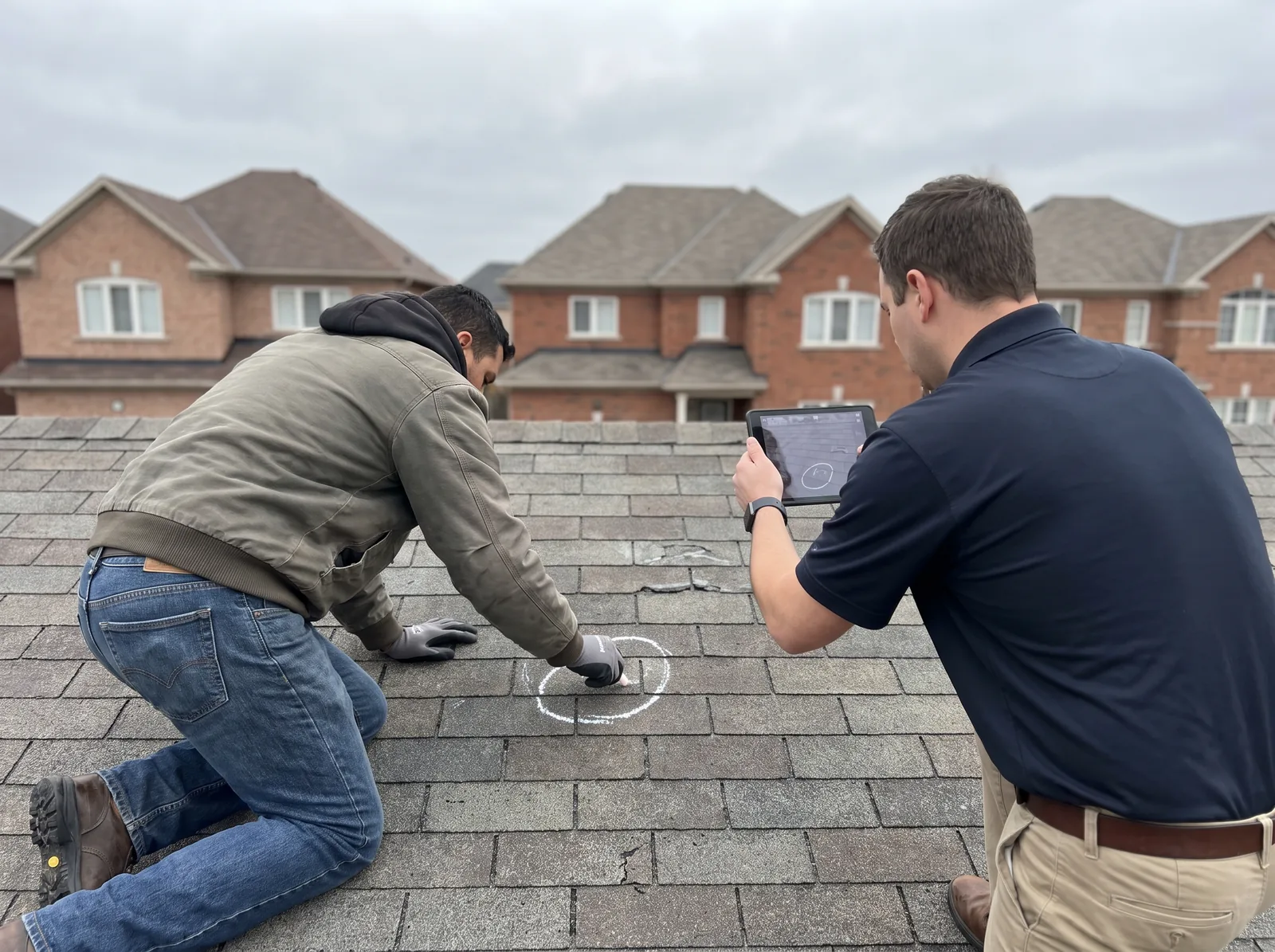
Don't file on a hunch. A claim that's inspected and denied stays on your CLUE report and follows the house. Have a registered roofer walk the roof, chalk the hits in test squares, count them per slope, photograph the soft metals, and tell you whether it's a claim. Our inspection is free and the report is yours either way. If the hit counts are low and your deductible is high, we'll tell you it's a repair, not a claim.
Step 2: Read your declarations page — it changed
Three things to find. The wind-and-hail deductible: many Oklahoma policies now carry a percentage deductible instead of a flat $1,000 — one or two percent of dwelling coverage, so $4,000 to $8,000 on a $400,000 house. The roof settlement basis: replacement cost (RCV) pays for a new roof minus the deductible; actual cash value (ACV) or a 'roof schedule' pays what your old roof was worth, which on a 15-year-old shingle roof can be 30 or 40 percent of new. A lot of Oklahoma roofs moved to ACV at renewal in 2024 and 2025. The notice period: some policies now require a storm claim within one year of the date of loss, a few within 180 days. Sit on a May storm until the leak shows up in November and you may be out of time.
Step 3: File, and meet the adjuster on the roof
File the claim yourself — by phone or the app — with the date of the storm and the roofer's report attached. The carrier assigns an adjuster; after a big storm it can take weeks. We meet the adjuster on the roof with the chalk marks still there and walk every slope together, because an adjuster alone with fifteen minutes and forty roofs to see will miss things, and things missed are things unpaid. The adjuster writes a scope and an estimate; you get a copy.
Step 4: The estimate, the supplement and the code items
We write our estimate in the same line-item format the carrier uses, matched to the approved scope. Then we supplement for what's missing: the ice-and-water barrier and drip edge the current code requires, the ridge vent, the second layer nobody knew about, the decking. If your policy has ordinance-or-law coverage — most do, at 10 percent of dwelling — the code items are covered when they're in the scope. This is paperwork, not a fight, and it's where a good roofer earns their keep.
Step 5: The deductible — and the law
You pay the deductible to the roofer. Under 59 O.S. §1151.30, in force since November 2022 and tightened in 2025, a roofing contractor may not advertise or promise to pay, waive or rebate any part of your deductible, or 'compensate' you for a service — a referral fee, a 'marketing allowance', a free upgrade — as a workaround. A roofer who does can have their estimate disregarded by your insurer entirely, and the contractor must give you a written notice of the rule with the initial estimate. Ours does. Pay the deductible, keep the receipt; your carrier can ask for it before releasing the depreciation.
Step 6: The work, the invoice and the depreciation
On an RCV policy the carrier pays the ACV up front and holds the depreciation until the roof is done. We finish, send the certificate of completion, the final invoice and photos, and the carrier releases the recoverable depreciation to you. If you upgraded — Class 4, FORTIFIED, metal — the difference is yours to pay, and some carriers contribute to a Class 4 upgrade; ask. On an ACV policy there's no second check, which is why it matters to know which one you have before you plan the roof.
What not to sign
A contingency agreement obligates you to use that roofer if the claim is approved, at whatever the insurer pays. An assignment of benefits hands your claim to the roofer. Neither is required to get an inspection, a tarp or an estimate, and both are how storm chasers lock up a roof the morning after a storm. We don't use either. Read how to spot a storm chaser.
If the claim is denied or underpaid
Ask for the denial in writing and the adjuster's photos. If our documentation shows damage the adjuster missed, we request a re-inspection with our report attached; most disagreements end there. If it doesn't, a licensed Oklahoma public adjuster (paid a percentage of the recovery) or an attorney is the next step, and the Oklahoma Insurance Department takes consumer complaints. We'll refer you and hand over everything we documented.
Related questions
How long do I have to file a hail claim in Oklahoma?
It depends on your policy, and it's shorter than it used to be — often one year from the date of loss, sometimes 180 days. The statute of limitations on the contract is longer, but the policy's notice requirement is what the carrier enforces. Read your declarations page or call your agent, and don't wait for a leak.
Will filing a claim raise my rates?
In Oklahoma, a weather claim usually doesn't raise your individual rate the way an at-fault claim does, but every claim goes on your CLUE report and carriers can non-renew after a pattern. That's one reason we tell you honestly when a roof doesn't have enough damage to file on.
What is 'ACV' on my roof?
Actual cash value: what the old roof was worth, not what a new one costs. Carriers apply a depreciation schedule by age — a 15-year-old shingle roof might be valued at 30 to 40 percent of new. If your policy moved your roof to ACV at renewal, a claim pays much less than you'd expect, and a Class 4 or FORTIFIED roof is often the way to get RCV coverage back.
Can the roofer talk to my adjuster for me?
We meet the adjuster and discuss the scope, and we submit supplements. What we don't do is take over your claim — you file, you're the policyholder, and the checks come to you. Anything that requires you to hand the claim to the roofer is a red flag.
Does the deductible law apply if I'm paying cash?
No — §1151.30 is about insurance claims. If you're paying out of pocket, we can offer whatever price we like. On a claim, the deductible is yours to pay, in full, with a receipt.
My roof is 18 years old and the adjuster says it's 'wear and tear.' Is that it?
Not necessarily. Hail bruises and wind creases are distinguishable from wear, and an 18-year-old roof can be storm-damaged. Our report separates the two. If the carrier's position is really about age, an ACV settlement may still be on the table, and the free inspection tells you what it's worth.